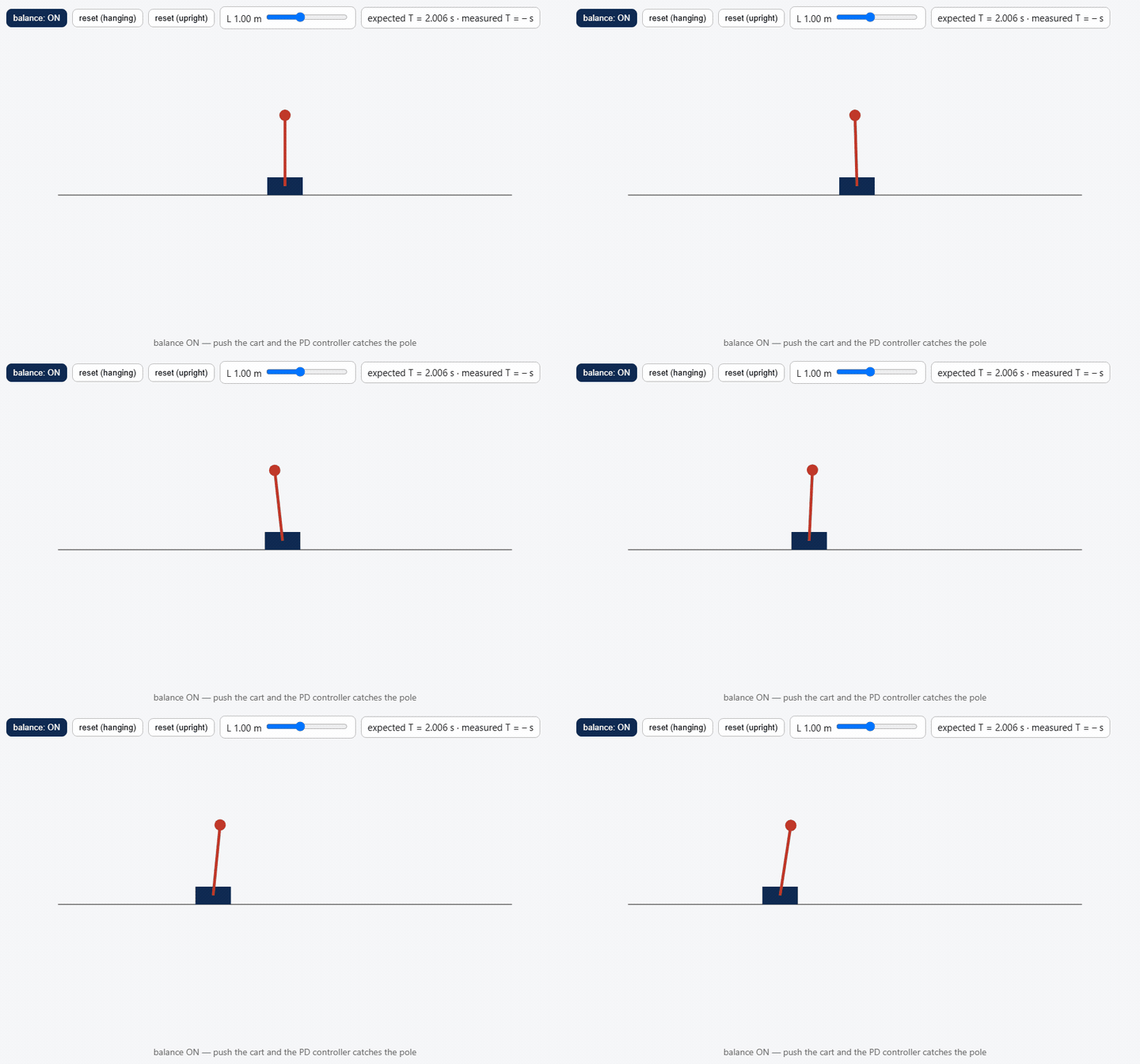
The check is the whole point
The specification named one number that could be predicted by hand, before a line of code was written: the small-swing period of a simple pendulum.
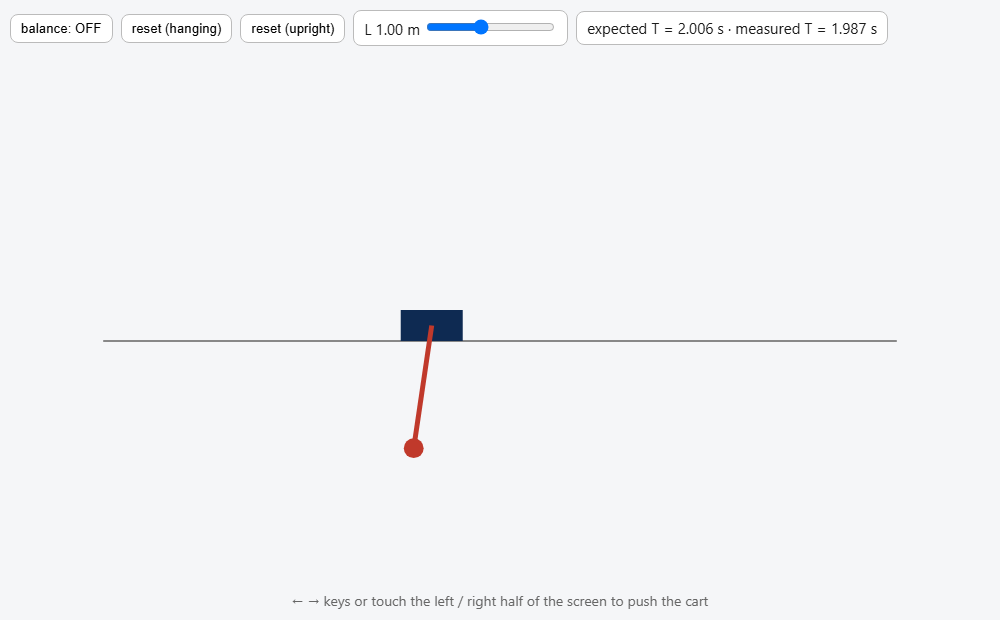
T = 2π√(L/g) = 2π√(1.00 m / 9.81 m s−²) = 2.006 sThe app measures its own period by timing successive crossings of the hanging position and prints it next to the prediction. Let the pole swing and the two numbers sit side by side on screen.
Why it is not exactly 2.006 s
Two real effects, both visible on screen, both predictable without touching the code.
The cart recoils. 2π√(L/g) assumes the pivot is nailed
down. This one is not: the cart is free to slide, so the pivot moves the other way as the
pole swings, which stiffens the oscillation and shortens the period by
√(M/(M+m)). With M = 5.0 kg and m = 0.2 kg that is a
factor 0.9806.
The amplitude is not small. Released with the bob moving at 1.2 rad s−¹
the swing reaches 22°, and a real pendulum slows as it swings wider —
lengthening the period by about 1 + θ₀²/16, a factor
1.0093.
Ideal small-swing period 2π√(L/g) | 2.0061 s |
× cart recoil √(M/(M+m)) | × 0.9806 |
× finite amplitude 1 + θ₀²/16, θ₀ = 22.1° | × 1.0093 |
| Predicted | 1.9854 s |
| Measured by the app | 1.987 s |
| Agreement | 0.1 % |
This is what a check is for. The first comparison was 1 % out. The useful response was not to shrug, and not to adjust the code until the numbers matched — it was to ask which physics the hand calculation had left out, put it back, and find agreement to 0.1 %. Both corrections were predicted on paper and then confirmed.
Separating the two corrections
You can switch one of them off. Make the cart heavy and it stops recoiling, leaving the
amplitude correction alone — so the period does not converge on 2.006 s, it lands
about 1 % above it. Edit const M in app/index.html:
| cart mass M | measured T | predicted | what is left |
|---|---|---|---|
| 5 kg | 1.9875 s | 1.9854 s | both corrections; they nearly cancel |
| 50 kg | 2.0208 s | 2.0207 s | recoil almost gone |
| 500 kg | 2.0250 s | 2.0243 s | amplitude only |
The 500 kg row is the cleanest result on this page: with the pivot
effectively fixed, 2π√(L/g) × (1 + θ₀²/16) =
2.0243 s against 2.0250 s measured. Two lines of algebra, four significant figures, no
fitting.